
Top Benefits of Pressure Washing Your Austin Home: Enhance Value, Health, and Curb Appeal
Pressure washing is a targeted exterior cleaning method that uses controlled water pressure and appropriate cleaning solutions to remove dirt, biological growth, and stains from home surfaces; in Austin, this service directly enhances value, health, and curb appeal for residential properties. This article explains the most important benefits Austin homeowners gain from professional pressure washing, including how cleaning restores appearance, prevents material degradation, and reduces allergen loads that affect indoor air. Many Austin properties face seasonal pollen, humidity-driven mildew, and sun-driven staining that erode paint and decking over time, and pressure washing interrupts those damage cycles while improving marketability. Read on to learn how pressure washing improves curb appeal, raises perceived property value, supports respiratory health, prevents structural damage, saves time and money, and prepares surfaces for painting and renovations. Each section includes practical guidance, comparison tables, and actionable checklists so you can apply these benefits to siding, driveways, decks, roofs, and gutters. Understanding these mechanisms will help you prioritize services and choose the right timing for Austin’s climate and real estate cadence.
How Does Pressure Washing Improve Your Austin Home’s Curb Appeal?

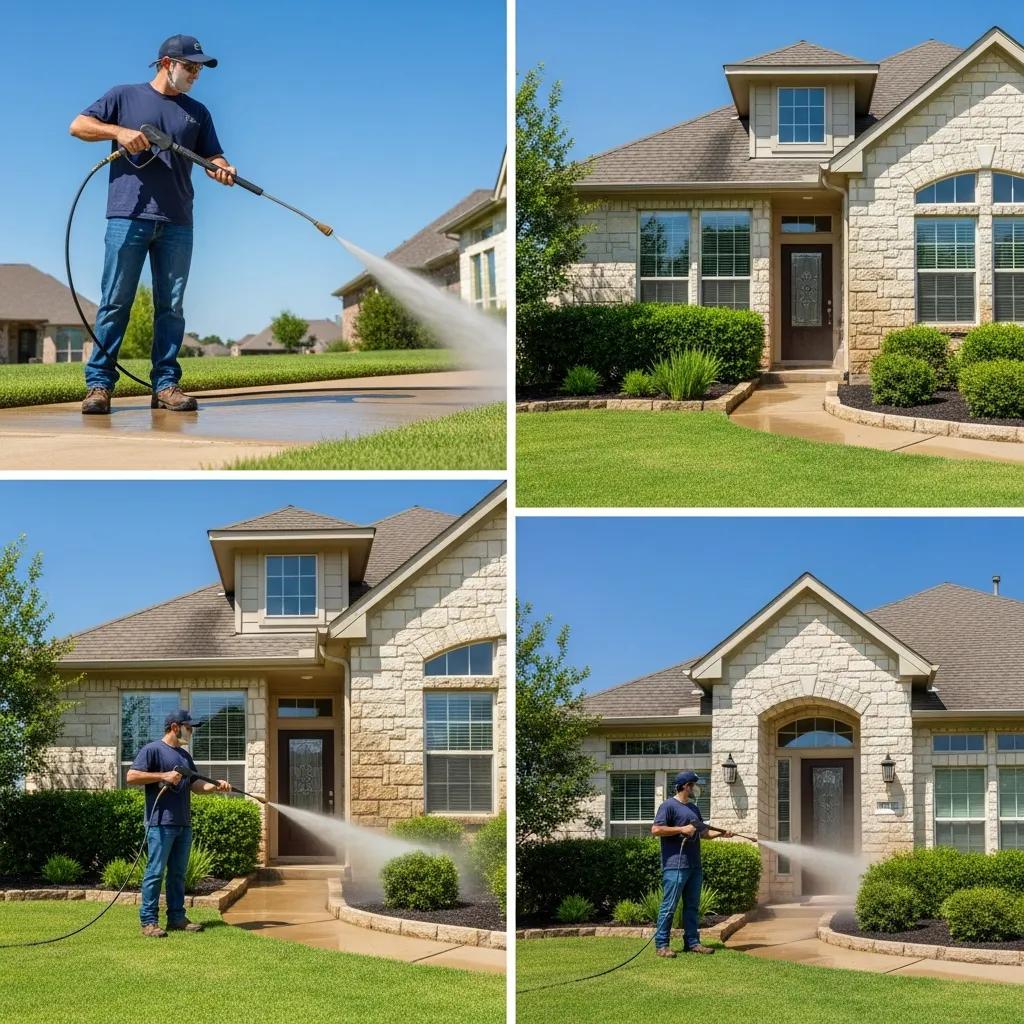
Pressure washing improves curb appeal by restoring the original color and texture of exterior surfaces, removing visual contaminants that distract buyers and passersby. The mechanism combines mechanical removal (water pressure and agitation) with chemical cleaning (detergents or soft-wash solutions), which together dissolve pollen, algae, oil, and grease to reveal cleaner siding, brighter driveways, and refreshed decks. Visible restoration happens quickly—driveways look less stained, porches appear more inviting, and overall property presentation becomes noticeably sharper—which leads to stronger first impressions at showings and open houses. The next paragraphs identify the common contaminants that obscure curb appeal and explain how those materials affect buyer perception and resale timing.
Pressure washing targets the most common visual offenders in Austin neighborhoods and restores the surface finish to improve photographic listings and curb appeal metrics.
H3: What Dirt and Grime Does Pressure Washing Remove to Restore Appearance?
Austin homes commonly accumulate pollen, mildew, algae, dust, bird droppings, oil stains, and general urban grime that dull paint and leave visible streaks on masonry and concrete. Pollen creates a thin, yellow-green film during spring that settles into textured siding and masonry, while humidity encourages mildew and algae growth on shaded walls and roof eaves, causing dark streaks and greenish discoloration. Oil and tire marks on driveways and garage aprons bond with road dust, producing stubborn stains that trap moisture and accelerate surface breakdown. Pressure washing removes these contaminants by disrupting biological films with detergents and rinsing particulate build-up, and when soft-wash methods are used, delicate finishes like wood siding or roof shingles are cleaned without high-pressure damage. Understanding the specific contaminant helps select the right cleaning chemistry and pressure setting for safe restoration.
Clean surfaces also photograph better and require less touch-up during staging, which improves the property’s appeal for immediate listings.
H3: How Does Enhanced Curb Appeal Affect First Impressions and Resale Value?
A well-maintained exterior creates a positive psychological impression that often translates into faster showings and stronger offers, because buyers equate visual maintenance with overall care of the property. Studies and market analyses routinely indicate that curb appeal factors influence buyer interest and perceived value; a clean driveway and fresh-looking siding reduce perceived deferred maintenance and can justify higher list prices or quicker sales. For a practical example, scheduling pressure washing a few days before listing removes visible stains that might otherwise prompt low-ball offers or inspection scrutiny, and the relatively small investment in cleaning frequently outperforms staging-only improvements in return on investment. Sellers who prioritize exterior cleaning report fewer negotiation hurdles tied to visible wear and tear.
Indeed, research consistently demonstrates the significant financial impact of a home’s exterior appearance on its market value.
Residential Curb Appeal Value & Home Sale Price
We recover the value of curb appeal in residential housing by using photos obtained from Google Street View, a deep learning classification algorithm and a variety of hedonic controls. We show that own property curb appeal is worth about twice that of an across the street neighbor. Together, neighbor and own property curb appeal together may account for up to 7% of a house’s sale price.
Valuing curb appeal, A Tidwell, 2020
Given the link between appearance and market reception, the next section explains how pressure washing contributes to measurable property-value outcomes.
In What Ways Can Pressure Washing Increase Your Austin Home’s Property Value?
Pressure washing increases property value both directly—by improving curb appeal and thus perceived market condition—and indirectly—by preserving materials to defer costly repairs that subtract from appraised value. When surfaces are cleaned regularly, siding, masonry, and hardscapes retain their finish and structural integrity, which supports higher comparative valuations during appraisals and buyer inspections. Regular exterior cleaning reduces the visual cues of neglect and signals to appraisers and buyers that systems are maintained, which can translate into higher offers or reduced time on market. The following table compares typical surfaces, the visual/value impact of cleaning, and the maintenance-cost reduction homeowners can expect from regular service.
Different exterior components contribute differently to perceived property value and maintenance budgets.
| Surface | Visual / Market Impact | Expected Maintenance Cost Reduction |
|---|---|---|
| Driveway (concrete/asphalt) | Removes oil and tire stains that lower curb appeal; cleaner driveways refresh overall facade | Reduces need for expensive resurfacing or sealing by several years |
| Siding (vinyl/wood/brick) | Restores original color and texture, improving listing photos and appraisal impressions | Slows paint failure and wood rot, lowering repaint and repair frequency |
| Deck & Patio (wood/composite) | Eliminates dark mold and mildew that suggest neglect, making outdoor spaces usable | Extends sealant/re-stain intervals and prevents costly board replacement |
This table highlights how prioritizing high-visibility surfaces during cleaning can support better market positioning and a reduced lifecycle cost of exterior components.
H3: How Does Pressure Washing Protect Your Investment and Boost Market Value?
Pressure washing protects investment value by removing biological growth and contaminants that retain moisture and initiate material breakdown, thereby slowing the progression to rot, paint failure, and surface erosion. For example, mildew and algae trap moisture against siding and wood decks, promoting fungal degradation that requires board replacement or intensive repairs if left unchecked. By interrupting that cycle through scheduled cleaning, homeowners preserve surface coatings and structural elements that factor into appraisals and buyer inspections. Regular cleaning also reduces the scope of visible deferred maintenance that real estate professionals often use as leverage for price concessions.
Protecting materials today directly reduces the magnitude of future capital expenditures, which supports better net valuation when the home is sold.
H3: What Role Does Pressure Washing Play in Real Estate Sales in Austin?
Pressure washing is a tactical pre-listing action that agents and sellers use to maximize visual appeal and minimize inspection flags, typically scheduled within a week before listing photography and open houses. Priorities include entryways, the front facade, driveway, and outdoor entertaining spaces because these areas have outsized influence on initial buyer impressions. In Austin’s competitive neighborhoods, a clean exterior can justify marginally higher pricing and accelerate the showing-to-offer timeline; it also reduces time spent negotiating cosmetic repair credits. Sellers should coordinate cleaning with staging and minor touch-ups so the house presents as move-in ready from first viewings.
Timing pressure washing correctly—close to listing—ensures surfaces remain clean through photos and early showings, which supports faster market traction.
What Are the Health Benefits of Professional House Washing in Austin?

Professional house washing improves health by removing mold, mildew, algae, and pollen from exterior surfaces, which reduces the reservoir of spores and allergens that can enter homes and aggravate respiratory conditions. The mechanism involves reducing outdoor biological loads so fewer spores become airborne near openings, lowering the baseline allergen exposure for occupants. Professional approaches combine appropriate detergents and soft-wash protocols to kill and remove organisms rather than merely dispersing spores, which provides a more durable reduction in biological growth compared with water alone. The next paragraphs explain removal methods and the relationship between exterior cleaning and indoor air quality.
Reducing exterior biological growth is an actionable way to lower household allergen pressure and support respiratory comfort for sensitive residents.
H3: How Does Pressure Washing Remove Mold, Mildew, and Allergens?
Effective removal of mold, mildew, and pollen relies on matching cleaning chemistry and pressure to the surface: soft-wash systems use low-pressure sprays with biocidal detergents to penetrate and neutralize spores on shingles, wood, and painted surfaces, while higher-pressure washing is reserved for hardscapes like concrete. Professionals select solutions that break down biofilms and kill spores at the surface, and then thoroughly rinse to prevent residue that could feed regrowth. For porous materials, follow-up treatments and targeted spot remediation may be necessary when deep-seated growth exists; cleaning alone is not a substitute for structural mold remediation when interior infestations occur. Choosing the right method reduces airborne allergen transfer and preserves material integrity.
The effectiveness of these professional methods is supported by research on antimicrobial agents used for surface mold control.
Antimicrobial Cleaners for Surface Mold Control
Antimicrobial agents, called fungicides, sporicides or biocides have long been used to remove, eliminate or control mold growth on surfaces. The efficacy of antimicrobial cleaners to remove, eliminate or control mold growth on surfaces can be significant.
ANTIMICROBIAL TREATMENTS OF MOLD AND BACTERIA., 2011
Understanding these technical differences helps homeowners select services that balance health outcomes with long-term surface preservation.
H3: Why Is Mold and Allergen Removal Important for Respiratory Health?
Removing outdoor mold and allergen sources lowers the amount of spores and pollen that can be drawn into living spaces through ventilation, open windows, and foot traffic, which in turn reduces triggers for allergy and asthma sufferers. While exterior cleaning is not a medical treatment and cannot guarantee symptom elimination, current research indicates that reducing environmental allergen reservoirs contributes to lower indoor allergen concentrations and fewer acute exposures. For households with sensitive occupants, combining exterior cleaning with indoor allergen control strategies—like filtered ventilation and regular HVAC maintenance—produces the most reliable improvement in respiratory comfort. Reducing the exterior source is therefore a practical, preventative step in a broader home health plan.
This preventative approach aligns with broader medical understanding of allergen avoidance for respiratory health.
Allergen Avoidance for Asthma Prevention
It is well known that combination of sensitization and exposure to inhaled environmental allergens is related to both the development and elicitation of symptoms of asthma and that avoidance of allergens would exert beneficial effects in the prevention and control of the disease. Other important factors include the relevance of other allergens, exposure to sensitizing agents also outside patient’s home, exposure to irritants (like chemical air pollutants), and the involvement of the patient with a correct education. It is also likely that clinical phase of allergic airway disease and the degree of airways remodeling represent relevant factors for the clinical outcome of allergen avoidance procedure. We reviewed existing evidence on prevention of asthma through allergen avoidance.
Prevention of allergic asthma with allergen avoidance measures and the role of exposome, 2020
Given these health and preservation benefits, the following section explains how cleaning interrupts damage cycles and extends material lifespan.
How Does Pressure Washing Prevent Damage and Extend Your Austin Home’s Lifespan?
Pressure washing prevents damage by removing agents that cause chemical, biological, and mechanical degradation of exterior materials, thereby extending the functional life of siding, paint, decking, and masonry. Biological growth holds moisture against surfaces, accelerating rot and paint delamination; pollutants and grit abrade finishes and provide micro-abrasion that weakens surface coatings over time. Regular cleaning reduces these stressors, and when combined with periodic inspections, allows homeowners to address small issues before they escalate into costly repairs. Recommended cleaning frequency in Austin typically aligns with seasonal pollen peaks and rainy periods, giving a schedule that interrupts growth cycles without over-washing sensitive materials.
Next we’ll outline specific damage types and precautions for different materials to help homeowners choose safe cleaning practices.
H3: What Types of Damage Does Pressure Washing Help Prevent on Siding and Paint?
Pressure washing prevents mildew staining, paint blistering, and surface erosion that occurs when contaminants bond with paint or raw wood, holding moisture and encouraging substrate breakdown. On wood siding and decks, removing organic growth reduces fungal colonization that leads to soft rot, while cleaned vinyl and masonry avoid the staining and mineral buildup that accelerate aesthetic decline. However, improper pressure or incorrect nozzles can damage paint and softer materials, so it’s critical to match pressure and technique to the substrate—soft-wash treatments for painted wood and shingles, and higher-pressure rinses for concrete and brick. Using the correct method preserves coatings and avoids inadvertent surface stripping.
Applying proper technique maintains protective finishes and minimizes the risk that cleaning itself becomes a source of damage, which we’ll contrast with regular schedule benefits next.
H3: How Does Regular Cleaning Protect Against Rot and Surface Degradation?
Regular cleaning interrupts the cycle of growth → moisture retention → rot by eliminating the organisms and residues that trap water at the surface, thereby improving drying rates and reducing conditions favorable to fungal decay. For wood elements, this means fewer instances of swelling, splitting, and softening that eventually require board replacement; for painted surfaces, it reduces the frequency of blistering and premature recoating. Establishing an inspection-and-cleaning cadence—typically annually or biannually in Austin—lets homeowners monitor finishes and sealants, plan repainting at appropriate intervals, and budget for preventive maintenance rather than reactive repairs. The result is an extended service life for exterior materials and lower total lifecycle cost.
For homeowners who prefer professional assistance to ensure safety and correct technique, a brief note on service options follows.
Georgetown Power Wash is a local Austin-area provider that positions itself as Austin pressure washing experts and can perform professional exterior cleaning with appropriate equipment and safety protocols. Hiring professionals helps ensure correct pressure settings and cleaning chemistry are used for each material to avoid accidental damage while maximizing preservation benefits.
How Can Regular Pressure Washing Save Time and Money for Austin Homeowners?
Regular pressure washing saves time and money by preventing accelerated deterioration that leads to expensive repairs and by avoiding time-consuming DIY projects that often deliver inferior results. Preventive cleaning extends repaint cycles, delays deck replacement, and reduces the frequency of heavy maintenance tasks—each of which lowers long-term expenditures and labor. When homeowners weigh time investment, rental equipment costs, and the learning curve for safe cleaning, professional services often provide better ROI because they deliver consistent outcomes with less risk. The next subsection offers a clear cost-benefit comparison and helps homeowners decide between DIY and professional approaches.
Understanding the financial trade-offs supports smarter maintenance planning and budget allocation.
H3: What Are the Cost Benefits of Professional vs. DIY Pressure Washing?
A cost-benefit comparison shows that DIY cleaning requires equipment rental or purchase, time for learning and execution, and carries higher risk of improper pressure settings that can cause damage requiring repair. Professionals bring calibrated equipment, appropriate detergents, and trained technique, which reduces repair risk and shortens project timelines; the upfront service fee is often offset by avoided repainting or replacement costs. DIY attempts frequently omit soft-wash methods for vulnerable surfaces, increasing the chance of stripping paint or gouging wood—costs that quickly exceed the savings of doing it yourself. For many homeowners, professional service provides a dependable balance of cost, time, and risk mitigation.
The table below summarizes common cost and time attributes for DIY versus professional approaches to help visualize expected trade-offs.
| Approach | Time Required | Average Cost Consideration | Risk of Damage | Expected Lifespan Extension |
|---|---|---|---|---|
| DIY rental/purchase | Several days including prep | Equipment + supplies; lower upfront but hidden costs | Moderate to high without experience | Variable; often lower due to improper technique |
| Professional service | Hours to a day for typical home | Service fee; predictable budgeting | Low with trained technicians | Higher due to correct methods and follow-up |
This comparison clarifies how professionals tend to deliver better long-term value despite higher initial cost because they protect asset longevity and reduce repair risk.
H3: How Does Pressure Washing Reduce Maintenance and Repair Expenses?
Pressure washing reduces maintenance and repair expenses by extending the intervals between repainting, resealing, and high-cost restorative projects; by keeping surfaces clean, the protective layers applied to wood, paint, and masonry function as intended for longer periods. For example, a well-maintained deck that receives periodic cleaning and sealing can avoid premature board replacement, and painted exteriors with fewer biological stains avoid accelerated paint failure that leads to larger repaint jobs. Establishing a schedule—annual soft-wash for siding and biannual cleaning for high-exposure areas—lets homeowners amortize preventative costs and shift budget from emergency repairs to routine upkeep. Over time, this proactive approach lowers total cost of ownership for exterior systems.
Given these economic advantages, the following section explains why professional-grade cleaning is essential before painting and renovations.
Why Is Pressure Washing Essential for Preparing Your Austin Home for Painting and Renovations?
Pressure washing is essential before painting and renovations because it removes loose paint, chalking, mildew, and dirt that interfere with adhesion, ensuring the new coating bonds to a clean substrate. Proper surface prep reduces the risk of premature paint failure and peeling, and creates a uniform base that improves finish quality and longevity. Professional washing removes contaminants that cannot be dislodged by sanding alone and reveals areas that need spot repair before coatings are applied. The next subsections provide a practical prep checklist and a step-by-step process to follow before paint or stain projects.
Ensuring correct surface preparation prevents costly callbacks and supports longer life for renovation investments.
H3: How Does Pressure Washing Ensure Proper Surface Preparation for Paint and Stain?
Pressure washing ensures proper surface preparation by thoroughly removing contaminants—loose paint granules, chalk residue, mildew, and grime—that create microscopic barriers between substrate and coating, which impede adhesion. The process typically follows: apply an appropriate cleaner to break down chalking and biofilm, allow dwell time for the chemistry to act, rinse at controlled pressure to remove residues, and allow adequate drying before sanding or priming. Professionals also inspect for underlying damage such as rot or failed flashing that must be repaired prior to painting. This sequence reduces the chance that the new paint will fail prematurely and extends the paint system’s expected service life.
Following cleaning with inspection and minor repairs completes the preparation cycle that supports durable finishes.
H3: What Is the Step-by-Step Process of Pressure Washing Before Renovations?
A reliable pre-renovation washing sequence includes preparation, application, rinsing, drying, and inspection: first move or protect landscaping and cover sensitive fixtures; next apply a surface-appropriate cleaning solution to remove biological growth and chalk; then rinse uniformly at the correct pressure and nozzle angle; allow the substrate to dry fully—often 24–48 hours depending on weather—and finally inspect, sand, and spot-prime as needed. Timing estimates depend on material and climate, but planning the wash 2–3 days before painting allows for drying and minor repairs while minimizing the window for recontamination. For porous or damaged substrates, professionals can recommend follow-up steps to ensure adhesion.
Following this ordered process reduces the risk of paint failure and supports longer intervals between major renovations.
Georgetown Power Wash can be engaged by homeowners who prefer a professional surface-prep solution prior to painting; experienced providers apply appropriate soft-wash and rinse protocols to protect materials and improve coating longevity.
- Professional prep reduces the likelihood of paint failures and callbacks.
- Correct cleaning chemistry and pressure settings preserve substrate integrity.
- Scheduling cleaning shortly before painting ensures optimal adhesion and finish results.
This final paragraph reinforces the role of professional cleaning in renovation planning while keeping the article focused on practical benefits and choices available to Austin homeowners.